
Life After the Coverage Cliff: How Americans Responded to Rising ACA Premiums
Arielle Elliott, Sr. Research Manager –
The ACA market was in a state of continuous growth beginning in 2021, fueled primarily by the enhanced subsidies established through the American Rescue Plan Act (ARPA) that year. Marketplace enrollment reached record highs each year from 2022 through 2025, culminating in 24.3 million plan selections for 2025 coverage, more than double the 2020 enrollment.1 That momentum came to a halt heading into 2026, when Congress did not extend the provisions further. The subsidy enhancement expired on December 31, 2025, returning subsidy eligibility and premium contribution requirements to their pre-2021 levels. During the 2026 OEP, enrollment fell by 1.2 million members.2
This decline in enrollment only continued to accelerate as the year went on and more consumers lost their coverage due to non-payment. By February 2026, the active ACA population had reduced further from 23.1 million in the OEP to just 19.2 million.3 The magnitude of this market reduction begs the question: What happened to the millions who lost enhanced ACA subsidies?
Such a substantial market shift opens new conversion opportunities for insurers in the individual health insurance market. The people who left the ACA after enhanced subsidies expired are a unique population. They are unusually conversion-ready because they recently demonstrated both insurance literacy and purchase intent. Unlike the chronically uninsured, these consumers have already demonstrated a willingness to navigate enrollment, compare plans, and pay premiums
The organizations best positioned to acquire them are those able to offer lower-cost coverage alternatives, supplemental protection products, or personalized enrollment assistance that addresses the affordability shock created by subsidy expiration. The largest opportunity segment is likely former ACA members who become uninsured. Many individuals who were paying $0-50/month suddenly faced premiums of $100-300+ per month after the subsidy enhancements ended. For lower-income but relatively healthy consumers, the increase crossed an affordability threshold. To restore this group’s willingness to join a plan, the primary barrier of entry would be access to options that meet their affordability needs. The former ACA members who shifted into employer-group coverage or Medicaid may, for the most part, be lost to the individual market; however, they still represent opportunities for brokers or carriers with supplemental/ancillary benefit offerings.
We surveyed 2,316 former ACA members who left the market within the past year. We anticipated that post-exit coverage decisions would differ based on state-specific policy environments and available alternatives.
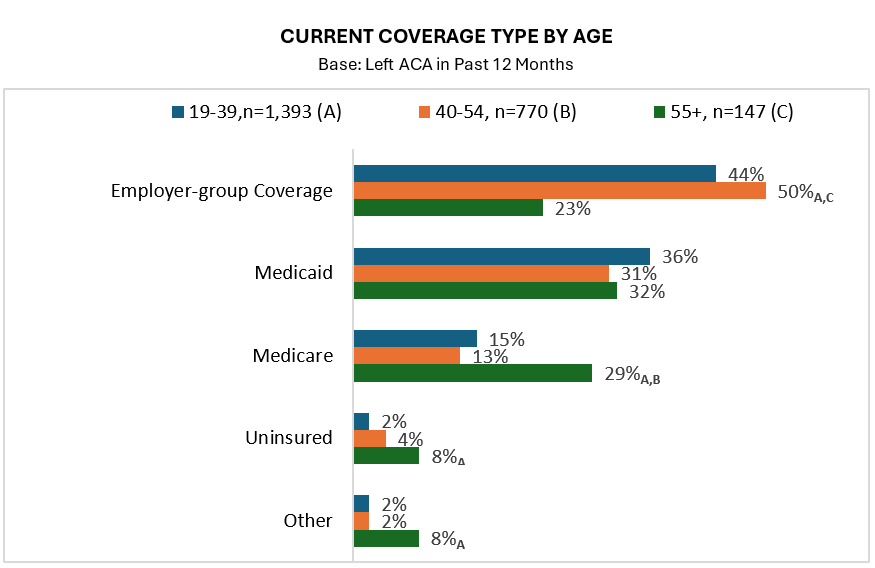
Overall, a quarter of 2026 ACA droppers indicated that they now have employer-group insurance. A third now have Medicaid, while 3% became uninsured and 2% moved into another coverage type, such as short-term coverage or association-based coverage. Disenrollees over 55 were more likely than younger former members to become uninsured. This over 55, pre-Medicare aged uninsured group represents a high-potential segment for both short-term coverage solutions and ACA reconversion efforts.
In Medicaid expansion states, such as Arkansas and Michigan, we see that former ACA members were particularly likely to transition into Medicaid after becoming eligible for public coverage. By contrast, former ACA members in non-Medicaid expansion states, such as Texas and Florida, may have faced fewer affordable coverage options, forcing a choice between becoming uninsured or seeking employment that offers health insurance. In employer-group-heavy states, many workers who left ACA coverage may find themselves in employer plans with high deductibles and costs for care. For these former ACA members, ancillary products may be appealing solutions to managing high costs for care.
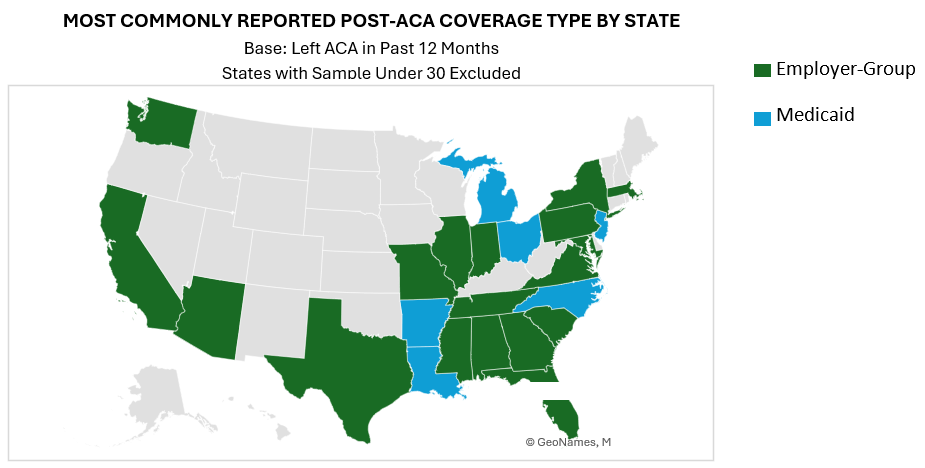
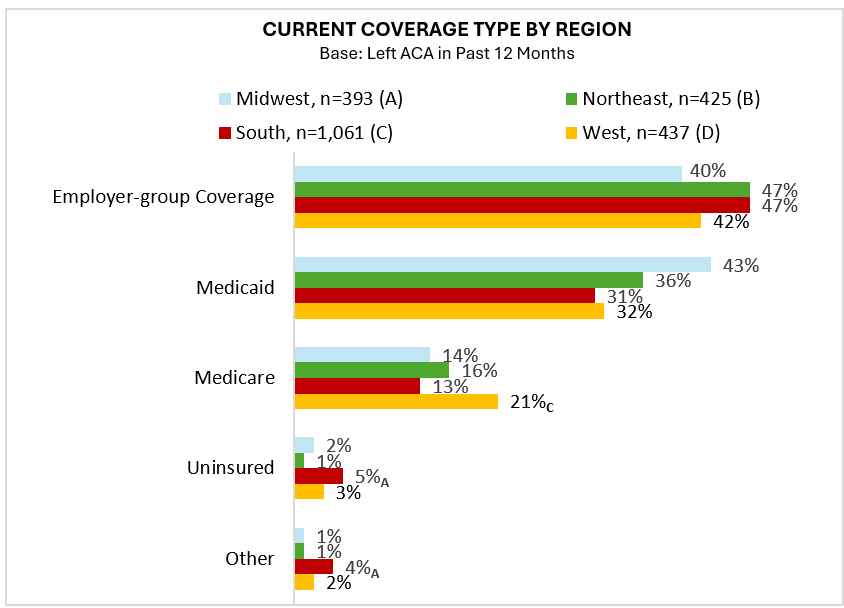
Transitions into employer-sponsored insurance also vary based on local labor market conditions, with states experiencing stronger employment growth potentially seeing more former ACA members obtain coverage through an employer, while states with fewer affordable alternatives would experience larger shifts toward uninsurance. Respondents in the South, the region that also showed some of the highest growth rates in IFP enrollment during the enhanced subsidy era, had the highest percentage of former members that became uninsured.
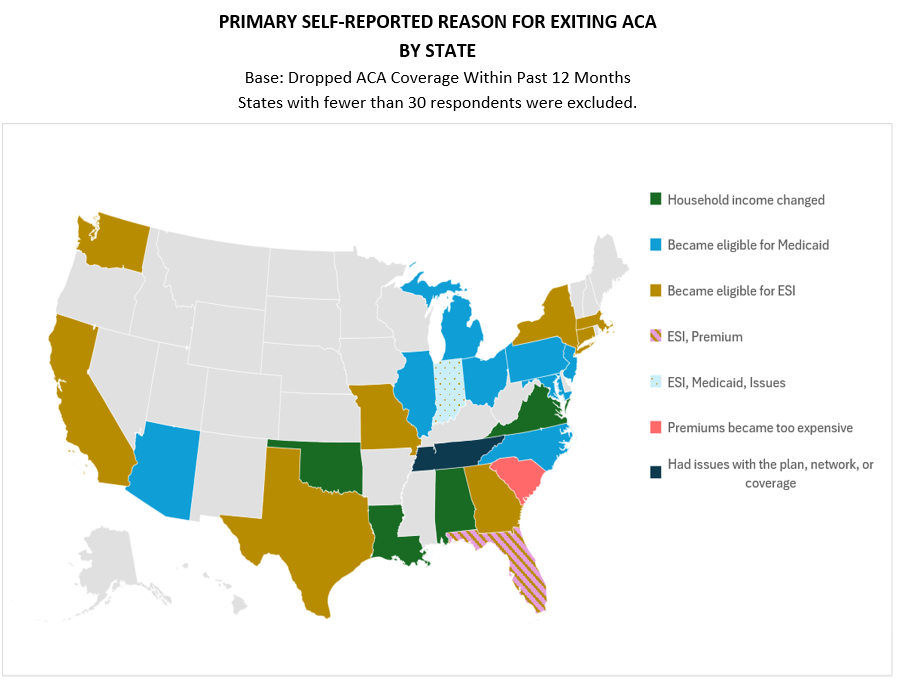
Respondents’ self-reporting of what drove them to disenroll reflected similar themes to those observed in their post-ACA coverage choice. One former enrollee from Texas commented, “It should no longer be called the affordable care act! Nothing about it is affordable.” Similarly, a now uninsured Californian explained that there were simply “too many hoops to jump through to keep it as a full-time caregiver.” Others left the Marketplace after finding different sources of coverage. One Georgia respondent reported, “I purchased a plan directly for my business,” while another former enrollee transitioned to Medicare after becoming temporarily disabled. The experiences of former ACA members show that addressing the needs and finding the potential opportunities among these disenrollees cannot be standardized. While affordability played an important role for many, others cited income changes, administrative challenges, or shifts in their personal circumstances.
Regardless of where they ended up, consumers who left the ACA following subsidy expiration may be especially responsive to messaging around affordability, stability, and protection against future disruptions. Rather than selling ancillary products on their standalone merits, marketers can position them as practical solutions to the coverage gaps and financial uncertainty created when Marketplace premiums suddenly became unaffordable. As the Marketplace adjusts to a post-enhanced-subsidy environment, understanding these varied experiences may help insurers and brokers identify opportunities to fill the gaps in these lost members’ healthcare.
- Deft Research, “IFP Member Experience” (2025)
- CMS, 2026 Marketplace Open Enrollment Period Public Use Files
- HHS.gov “ACA Exchange Enrollment in 2026”